#ai-models#industry#openai
OpenAI Announced Three New Models Today. You Can't Use Any of Them.
OpenAI just announced three new GPT-5.6 models — Sol, Terra, and Luna. All three are locked behind government-approved access only. Here's what they are, what they cost, and why the precedent being set should concern everyone.
On this page · 6
OpenAI Announced Three New Models Today. You Can't Use Any of Them.
Sixteen days ago, we wrote about the US government shutting down Claude Fable 5 — pulling the most capable AI model ever released offline over a "jailbreak" that other models can already do. We called it a dangerous precedent.
Now that precedent has teeth.
Today, OpenAI announced GPT-5.6 — their most powerful model family yet. It comes in three variants: Sol, Terra, and Luna. And every single one of them is locked behind government-approved access only. Roughly 20 organizations got in. You didn't.
Here's the thing — this isn't a soft launch or a research preview. This is the Trump administration's executive order from June 2 in action: a mandatory vetting framework where the federal government reviews frontier AI models for up to 30 days before public release. The framework isn't even fully built yet, but it's already controlling who gets access.
The Three Models
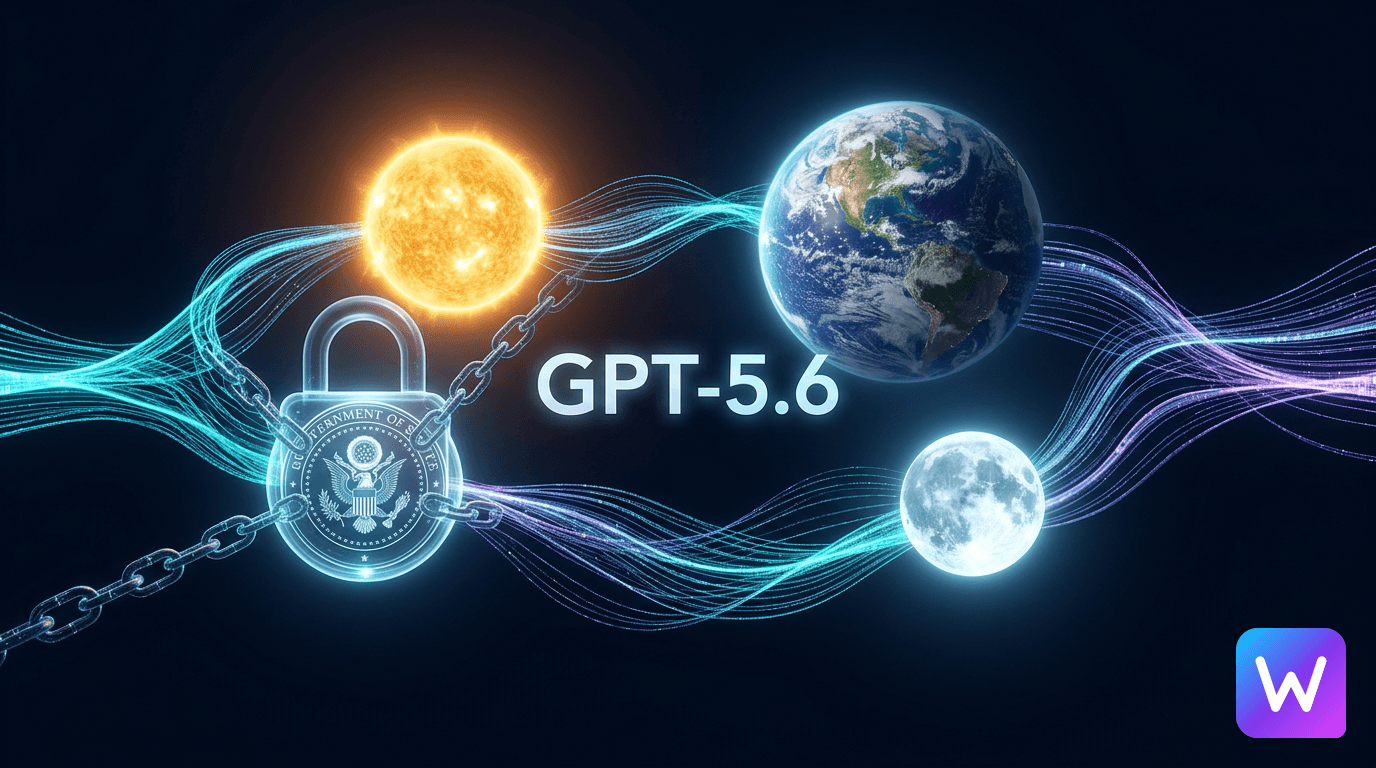
OpenAI's new naming scheme ditches the "mini" and "nano" suffixes. Instead, they've gone celestial — and the three models serve very different purposes:
| Model | Purpose | Input (per 1M tokens) | Output (per 1M tokens) |
|---|---|---|---|
| Sol 🌞 | Hardest problems — complex coding, security research, agentic workflows | $5.00 | $30.00 |
| Terra 🌍 | High-volume business — customer support, docs, internal tools | $2.50 | $15.00 |
| Luna 🌙 | Everyday tasks — summarization, drafting, routine automation | $1.00 | $6.00 |
Sol is the flagship — priced identically to GPT-5.5 but with what OpenAI claims is a major performance jump on long-running coding, cybersecurity, and agentic tasks. It's the model you'd reach for when the problem is genuinely hard.
Terra is the workhorse. Half the price of Sol, designed for production environments that need reliable results at scale. Think enterprise pipelines processing thousands of requests per hour.
Luna is the one that should have everyone's attention. At $1/$6 per million tokens, it delivers performance near GPT-5.5 levels — a model that currently costs $5/$30. That's a 5x price reduction for near-equivalent intelligence. Read that again.
The Classification Problem
Here's what the headlines aren't covering: OpenAI's new system card classifies all three models — not just Sol — at its "High" risk level for both cyber and biological/chemical capability.
That means even Luna, the lightweight everyday model, carries the same risk classification as the flagship. If this framework becomes permanent, it won't just be Sol getting gated. Every tier of OpenAI's lineup could require government approval.
Let's be real — when a $1/token model gets the same security classification as a $30/token model, the gating mechanism isn't about capability anymore. It's about control.
The Anthropic Connection
Hours after OpenAI's announcement, the White House partially lifted restrictions on Anthropic's Mythos 5 — but only for "cyber defenders and infrastructure providers." Not the public. Not developers. Not you.
Anthropic's Fable 5? Still offline. Completely.
So the current state of frontier AI in America, as of today:
| Model | Status |
|---|---|
| GPT-5.6 Sol | 🔒 Government-approved partners only |
| GPT-5.6 Terra | 🔒 Government-approved partners only |
| GPT-5.6 Luna | 🔒 Government-approved partners only |
| Claude Mythos 5 | 🔒 Cyber defenders only |
| Claude Fable 5 | ❌ Completely offline |
| GLM 5.2 | ✅ Open weights, MIT license, anyone can use |
One of these things is not like the others. And it's from China.
What This Means for WindOp
For WindOp users, this news cuts both ways:
- Luna is the model we've been waiting for. When GPT-5.6 Luna eventually reaches public API access, it means WindOp users get near-GPT-5.5 intelligence at a fraction of the cost. That translates to faster, cheaper coding workflows — more tokens for the same budget.
- The pricing signal is clear. OpenAI is aggressively pushing the cost of capable models down. Luna at $1/$6 is the cheapest frontier-class pricing we've seen from OpenAI. This trend benefits every WindOp user running AI-assisted workflows.
- Open weights matter more than ever. The Fable 5 shutdown, the government vetting of GPT-5.6 — it all reinforces why GLM 5.2's MIT license matters. Models that can't be taken away by government decree are models you can build on with confidence. WindOp's OpenRouter integration means you always have options.
- We'll add GPT-5.6 models the moment they're available. When OpenAI opens public API access — which they've said is coming "in the coming weeks" — Sol, Terra, and Luna will be available as model options in WindOp immediately.
The Bottom Line
The executive order's framework deadline is July 2. That's six days from now. If the vetting process concludes on schedule, we could see public access to GPT-5.6 models by early July.
But here's what should bother you: a year ago, the idea that the US government would gatekeep which Americans can use which AI models would have been unthinkable. Today it's Tuesday.
The models look incredible. The precedent is terrifying. And the only frontier model you can actually use right now is the open-weights one from China.
This isn't speculation — that's the pattern forming in real time.
— Zach, CEO/Co-Founder
Keep reading
Related posts
You Don't Need Frontier Prices to Get Real Work Done Anymore. GLM 5.3 Flash and MiMo V2.6 Pro Prove It.
GLM 5.3 Flash and MiMo V2.6 Pro both landed this month with near-frontier benchmarks at a tenth of the price. Both are MIT open weights. Both are on OpenRouter. Cost-per-task just became the only metric that matters.

OpenAI Just Cut Prices 80%. The Open-Weight Revolution Forced Their Hand.
OpenAI slashed GPT-5.6 Luna prices by 80% just three weeks after launch. Chinese open-weight models now dominate 66% of OpenRouter traffic. The AI price war is here.

The White House Wants to Ban Open-Source AI. Here's Why It Won't Work.
Kimi K3 matched Claude Fable and GPT-5.6. Now the Trump administration is threatening sanctions on Chinese open-weight models — and OpenAI is cheering them on. The fourth chapter in our Government Gate series.